Electrician insurance
Wiring, boards and installs put your liability on the line at every job. This cover handles injury and damage to other people's property.
Cover for domestic, commercial and industrial electrical work, on site or in a client's home.
Public Liability from €21.84 per month, with €2.5 million of cover per claim.
Insurance in minutes, no long-term commitment, cancel any day.


Business insurance, done differently.

Fully online business insurance in Ireland.

A few questions and you're covered.

No lock-in, no long contracts.

Excess from €0, up to €6.5 million of cover.
Why take out business insurance as an electrician?
Electrical work carries liability that follows you from the van to the consumer unit. Here is why dedicated electrician insurance matters:
A fault can injure someone: A loose termination, a mis-wired board or an unearthed circuit can hurt the person who uses it. Construction Liability takes care of your defence costs and the compensation due.
You work in other people's buildings: Chasing walls, lifting floors and drilling through finishes. Damage to property in your care, custody or control is covered as standard, up to €25,000 per claim on your own, or €50,000 if you employ anyone.
Putting work right costs money: If a job has to be redone, the optional cost of additional work cover pays up to €25,000 per claim on your own, or €50,000 with staff, after a €500 excess.

What is Public Liability insurance?
If a third party, like a client or a member of the public, holds you responsible for an injury or for damage to their property, Public Liability takes care of your defence costs and any compensation due.
What does it cover?
Injury or property damage caused to others in the course of your electrical work. Your cover limit is €2.5 million per claim and €5 million per insurance year. Damage to property in your care, custody or control is included, up to €25,000 per claim on your own or €50,000 if you employ anyone.
What can you add?
Employers' Liability, €13 million per claim, if you employ anyone.
Cost of additional work, up to €25,000 per claim on your own or €50,000 with staff, subject to a €500 excess, for putting faulty work right.
Cover that fits your trade
You describe your work fully at sign-up, and your cover matches what you actually do: electrical building installations, light and power, low voltage data and network wiring, and fibre-optic cable.
Work you have to declare
Some of what you tell us changes your premium, and some of it means we need to look at your business before we can quote. As an electrician you are asked about:
Fire-hazardous work: any work involving heat, such as welding, cutting, grinding, flame soldering, paint stripping, bitumen burning, and work with hot air such as blow-drying. Your answer affects your premium.
Subcontractors: whether more than 50% of your revenue comes from subcontractors, meaning people you hire to carry out work on your behalf. If it does and your annual revenue is above €500,000, we need to look at your business before we can quote.
Experience: whether you have at least 3 years of experience with the activities your company carries out. You are only asked this if your business has been trading for less than 36 months, and your answer affects your premium.
Revenue from outside the European Union: whether more than 50% of your revenue comes from outside the European Union. If it does, we need to look at your business before we can quote.
Is it mandatory?
Public Liability is not required by law in Ireland. In practice, main contractors, letting agents, facilities managers and local authorities ask for proof of cover before they let you on site. Cover starts from €21.84 per month.

What does our insurance cover for electricians?
Cover for electricians is built around Public Liability on the construction rating, with optional covers you can add to match your situation.
Public Liability: Protects you if a client or another third party suffers an injury, or their property is damaged, in the course of your electrical work. It takes care of your defence costs and any compensation due. Your cover limit is €2.5 million per claim and €5 million per insurance year.
Third-party objects and sites: Included as standard on this trade. Covers damage to property belonging to others that is in your care, custody or control, such as the building you are working in, up to €25,000 per claim on your own or €50,000 if you employ anyone.
Employers' Liability (optional): If you employ staff, this covers your liability as an employer, with a limit of €13 million per claim.
Cost of additional work (optional): Covers the necessary and reasonable cost of putting faulty work right, up to €25,000 per claim on your own or €50,000 with staff, after a €500 excess.
What's covered
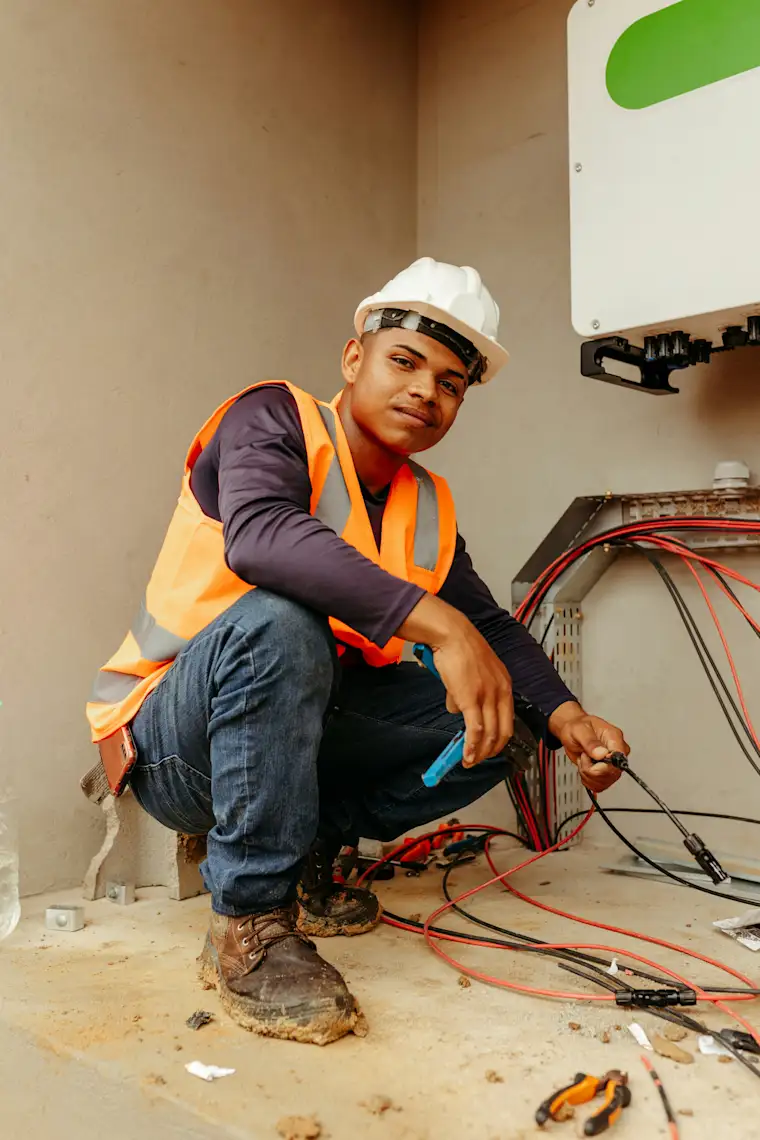
Construction, installation, modification, maintenance and repair of electrical building installations, light and power installations
Connection of electrical equipment and simple low voltage installations (such as internet and network wiring)
Construction, installation, maintenance and repair of fibre-optic cables
Trade in related construction goods and materials
Use of land, buildings or premises for the insured activity
Optional: Employers' Liability if you employ anyone (€13 million per claim)
Optional: cost of additional work, for putting faulty work right (€25,000 or €50,000 per claim, €500 excess
Work on solar cells, solar collectors, solar panels or collectors for water heating
Work on lifts or escalators
Work on lightning conductors
Activities outside the European Union, Iceland, Liechtenstein, Norway, Switzerland and the United Kingdo
Cover and exclusions shown are indicative and non-contractual. Only the terms of your policy apply.
Claim examples for electricians
You rewire a shop unit in Cork and a socket you terminated overheats, burning the counter and the stock behind it. The owner holds you responsible. Public Liability takes care of your defence costs and the compensation due.
While running cable through a ceiling, you put a drill through a water pipe and flood the floor below. The damage to the building is covered.
A tenant trips on a length of flex you left across a hallway in a Dublin apartment block and breaks a wrist. Public Liability covers your defence costs and the compensation due.
You rewire a shop unit in Cork and a socket you terminated overheats, burning the counter and the stock behind it. The owner holds you responsible. Public Liability takes care of your defence costs and the compensation due.
While running cable through a ceiling, you put a drill through a water pipe and flood the floor below. The damage to the building is covered.
A tenant trips on a length of flex you left across a hallway in a Dublin apartment block and breaks a wrist. Public Liability covers your defence costs and the compensation due.
Examples are for illustrative purposes only. Compensation depends on the exact circumstances of the claim. No rights can be derived from these examples.
Your business insurance with Insify SmartGuide
Taking out insurance can be quick. Making sure you have the right cover is another matter. With Insify SmartGuide, you don't sign a contract blindly. You ask all your questions, and get clear, immediate and personalised answers, before you take out a policy.
Are you covered if you accidentally damage a client's equipment while working?
What excess should you choose?
Are you protected in the event of a dispute with a client?
Insify SmartGuide guides you step by step to understand what's covered, what isn't, and why. In just a few clicks, you build insurance that's truly tailored to your business, with complete confidence. Try Insify SmartGuide. Understand your insurance before you need it.

How to choose the right insurance as an electrician?
Criteria to compare:
The cover offered: Check that the policy matches the real risks of the work; injury from a fault you left behind, damage to the building you are working in, and every type of installation you take on. Make sure each one is covered.
The price: Compare premiums, but an attractive price can hide exclusions that matter on electrical work.
The excess: Know what stays at your own expense when a claim happens.
The exclusions: Watch for the ones specific to the trade; work you have not declared, specialist installations, and marketing that promises guaranteed results.
The service: Check how you get answers before you buy, not after a claim. An insurer that understands electrical work will ask about the installations you actually take on.
Mistakes to avoid: Do not settle for a generic policy that ignores the risks of electrical work. To secure your business today, discover our Public Liability insurance.
More than 40,000 entrepreneurs trust us
When I had to make a claim, I was amazed how quickly and efficiently it was handled. Within a few days I had a resolution.
Very friendly, quick and thorough. It gives me real confidence in taking out the cover. The company feels genuinely transparent, exactly what I look for. You don't find that often.
Very friendly, quick and thorough. It gives me real confidence in taking out the cover. The company feels genuinely transparent, exactly what I look for. You don't find that often.
When I had to make a claim, I was amazed how quickly and efficiently it was handled. Within a few days I had a resolution.
The cover itself was sorted quickly, and when I later needed support I got that fast too.
Very friendly, quick and thorough. It gives me real confidence in taking out the cover. The company feels genuinely transparent, exactly what I look for. You don't find that often.
When I had to make a claim, I was amazed how quickly and efficiently it was handled. Within a few days I had a resolution.
The cover itself was sorted quickly, and when I later needed support I got that fast too.
Answers to your questions about our insurance for electricians
The price depends on your turnover, the work you do, your headcount and the excess you choose. At Insify, Public Liability for an electrician starts from €21.84 per month. Electrical work is rated on our construction basis, which is why it starts higher than trades that carry less risk of injury and property damage. A personalised quote takes a few minutes online, and you can adjust the excess to see how it moves your premium.
Public Liability is not required by law in Ireland. In practice you will be asked for it constantly. Main contractors will not let you on site without a certificate, letting agents and facilities managers ask before handing over keys, and local authorities and public tenders set their own minimum limits. Having cover in place also means you are not personally exposed if someone claims against you after an injury.
Not as standard. Public Liability covers injury and damage to other people and their property, not the cost of redoing your own work. The optional cost of additional work cover pays the necessary and reasonable cost of putting faulty work right, up to €25,000 per claim if you work on your own or €50,000 if you employ anyone, after a €500 excess. If a fault you left behind injures someone or damages the building, that part is Public Liability.
Electrical work is rated on our construction basis, and that comes with a single cover limit of €2.5 million per claim and €5 million per insurance year. Trades on our general rating can choose between €1.25 million, €2.5 million and €6.5 million, but that choice is not available here. If a contract or a tender asks you for more than €2.5 million, tell us before you buy so we can check whether we can cover the work.
Yes, and on this trade it is included rather than optional. Damage to property belonging to others that is in your care, custody or control is covered up to €25,000 per claim if you work on your own, or €50,000 if you employ anyone, and up to twice that per insurance year. That is the cover that responds when you put a drill through a pipe or crack a finish while running cable. Damage to your own tools and van is not covered.
No. Work on solar cells, solar collectors, solar panels and collectors for water heating is excluded, and so is work on lifts, escalators and lightning conductors. If any of that is part of what you do, tell us before you buy rather than after, because a claim arising from excluded work is not covered. We would rather turn the work away than leave you thinking you are covered for it.
The excess is the part of a claim you pay yourself. If a claim settles at €4,000 and your excess is €500, you pay €500 and Insify pays €3,500. The options are €0, €250, €500, €1,000 and €2,500, with €0 and €250 available up to €500,000 annual revenue; above that the minimum is €500. A higher excess usually lowers your premium but means more out of pocket when a claim happens. The optional cost of additional work cover carries its own €500 excess.
Yes. Employers' Liability is a separate optional cover with a limit of €13 million per claim, and it is not part of your policy unless you add it. Employers' Liability is not compulsory in Ireland, unlike the United Kingdom, but you are still liable as an employer. Your headcount also changes your third-party property limits, which move from €25,000 to €50,000 per claim once you employ anyone.
You describe your work and your business when you get a quote. As an electrician you are asked whether you carry out fire-hazardous work, whether more than 50% of your revenue comes from subcontractors, and whether more than 50% of your revenue comes from outside the European Union. If you have been trading for less than 36 months, you are also asked whether you have at least 3 years of experience with the work your company carries out. Some of those answers change your premium. Two of them mean we need to look at your business before we can quote: revenue from subcontractors above 50% when your annual revenue is above €500,000, and more than 50% of revenue from outside the European Union. At the final step you also confirm that no insurance company has refused or cancelled insurance for your company in the last 5 years, and that in the last 8 years there has been no crime involving you or your owners, directors, partners or board members. If either of those is not the case, we look at it before we can offer cover. Declare everything you do: work you have not declared is not covered, and neither is a claim you already knew about when your cover started.